Apple’s Sunflower Returns
Apple’s rumoured home hub revives the iMac G4’s “sunflower” design — and makes the user the centre of orbit.
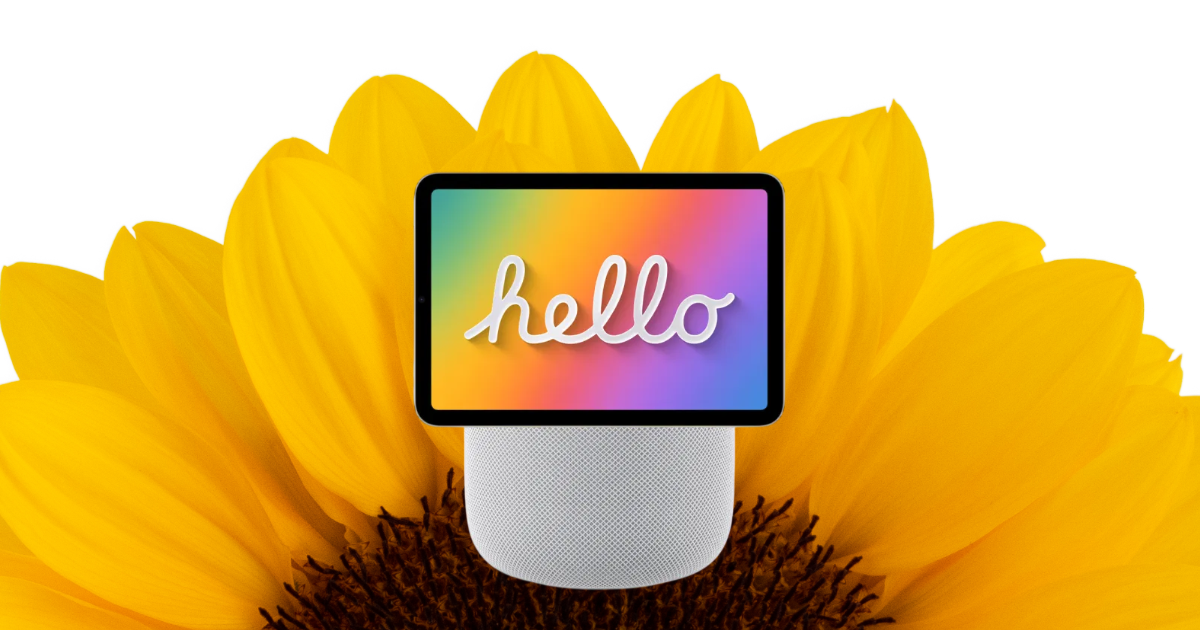
There's an old myth about a nymph named Clytie, who loved Helios and was loved back, until one day he wasn't hers anymore. She sat where she was so long, watching him cross the sky every day, that eventually she was turned into what we now think of as a sunflower [1], rooted to one spot, doomed to spend eternity turning her face toward the thing she loved, forever just out of reach.
A sunflower’s physical form is oriented towards a source of light because there's a measurable payoff for it.[2] Young sunflowers track the sun across the sky; mature ones settle facing east. Its shape and movement have a functional relationship with its environment. Nature solves problems by orienting things towards what they need. The best industrial design starts with what we need, rather than asking us to adapt to the object itself.
According to Bloomberg’s Mark Gurman, Apple's rumoured home hub (thought to be called the HomePad) will borrow its design language from one of the most beloved computers Apple has ever made, and in my view one of the best-designed too: the iMac G4.[3] To understand why the HomePad’s rumoured design is worth getting excited about, and why it’s relevant to sunflowers, we need to go to Steve Jobs’ garden in 2001. Apple had just shipped the first iMac, the gumdrop-shaped, candy-coloured G3, and was trying to work out what came next. CRT was on its way out. LCD panels were becoming practical, and the big glass tube that had dictated the shape of computers (and televisions) for decades was disappearing. This opened up whole new design languages and possibilities.
The story, as told by Walter Isaacson in his Steve Jobs’ biography, is that Jobs and Jony Ive were working through ideas in Jobs’ garden, surrounded by sunflowers. A key idea emerged: what if the screen could be separated from the base, like a sunflower?[4]
The idea gave birth to the design of the iMac G4. It had a hemispherical base containing the computer, which was extremely heavy (enough to anchor the whole thing), with a thin LCD panel mounted on an exquisitely engineered articulated steel arm. The screen could tilt, swivel and move up and down. Apple described it as a display that “floats in mid-air”, adjustable simply by touching it.[5]
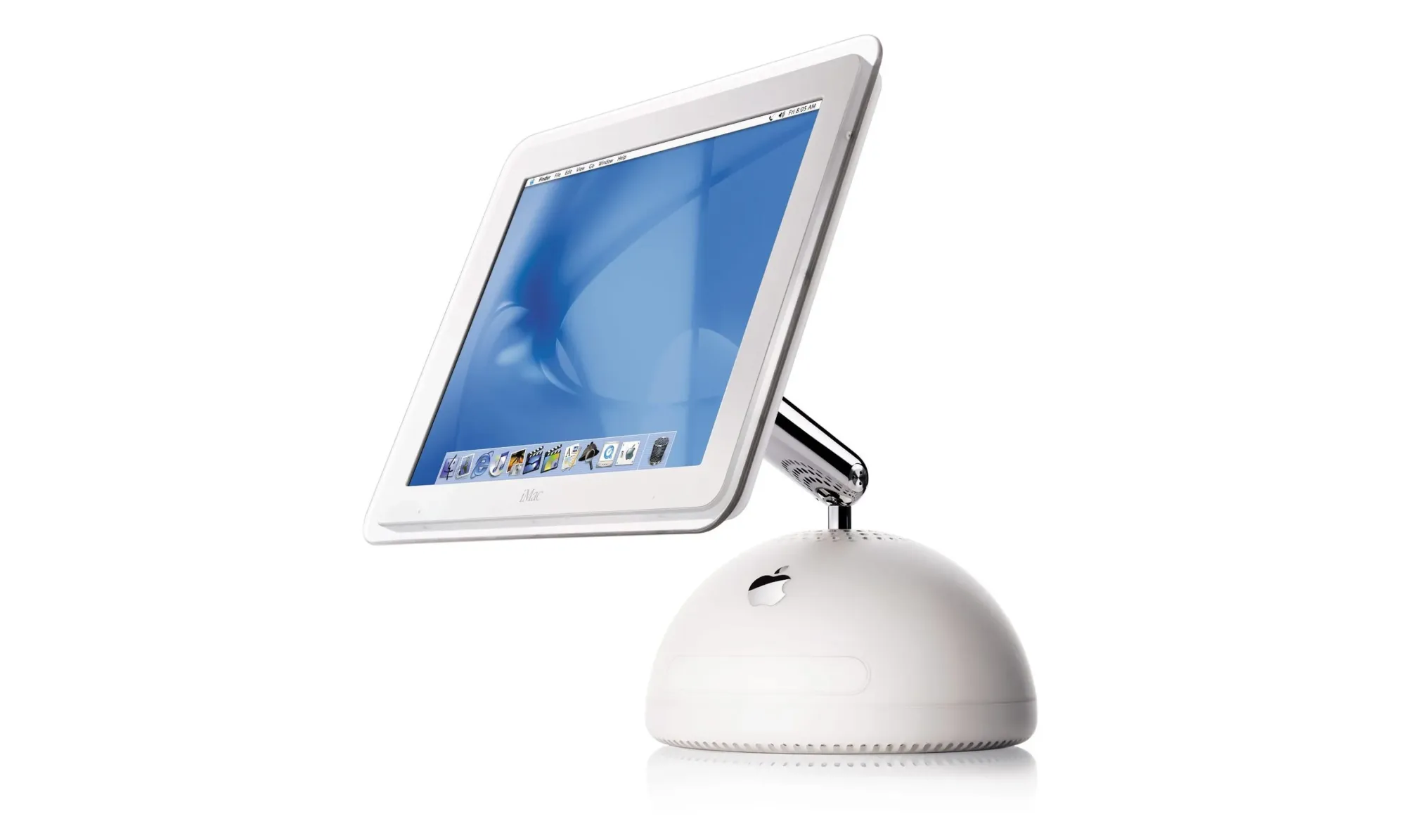
A conventional computer assumes the screen is the fixed gravitational centre. The G4 made the screen orient itself around you. The arm meant the display could move, tilt and swivel. The hemispherical base stayed in place while the screen could float above the desk and be positioned where you actually wanted it.
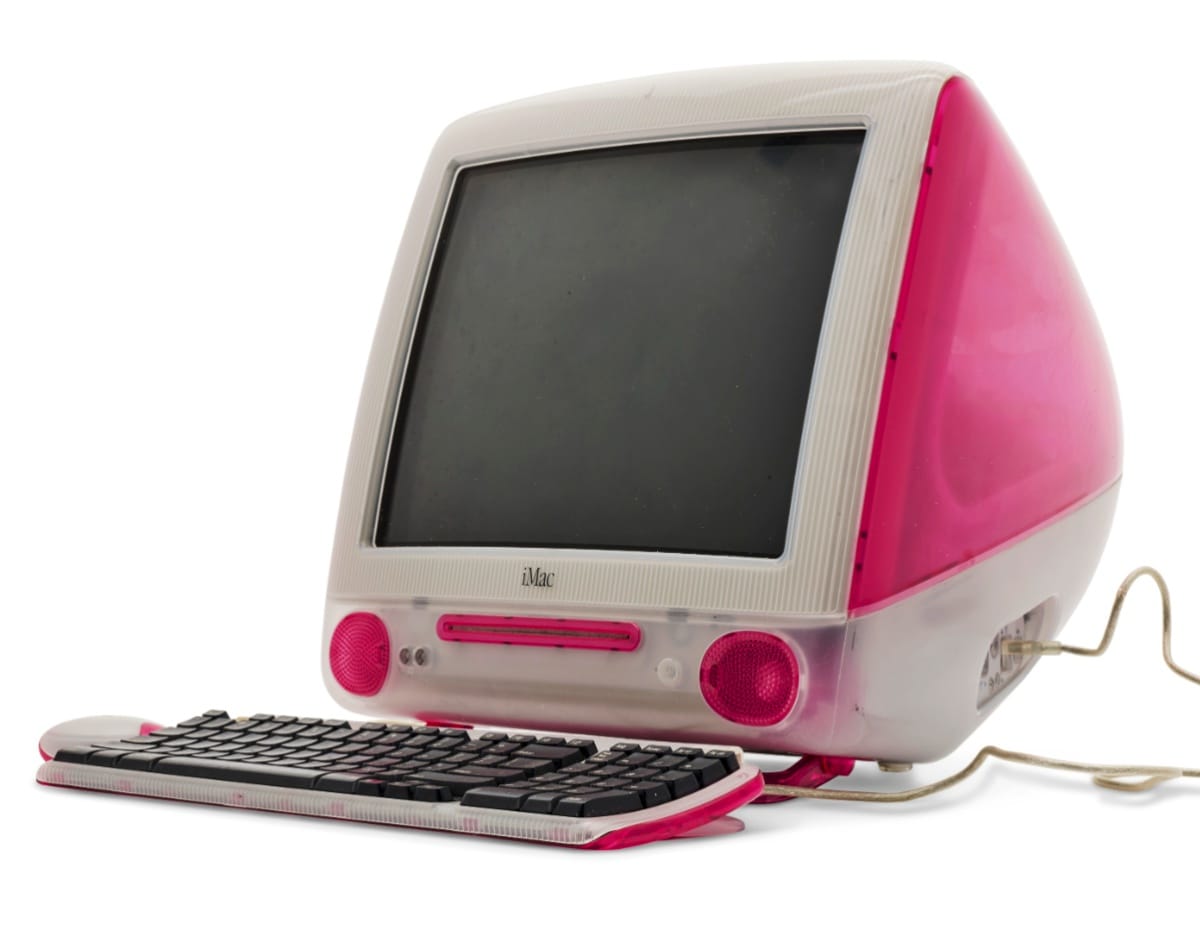
The iMac G4 was adored, and there’s still a small cottage industry devoted to keeping it alive, in various forms. People have turned G4s into monitor stands, iPad docks [6] and desk lamps. Juicy Crumb Systems makes the DockLite G4, a replacement logic board that turns compatible 17 and 20-inch iMac G4s into modern external displays while retaining the original enclosure, speakers and the wonderful, cantilevered arm.[7] There are projects putting modern M4 Mac Minis inside the old G4 enclosure, effectively turning an almost 25-year-old computer into a modern Mac.
The iMac G4 launched with a 15-inch screen in January 2002. A 17-inch model followed that summer, and the range eventually grew to a 20-inch version in November 2003 (which needed an even heavier base).[8] But in August 2004, Apple replaced it with the iMac G5: a much more conventional machine, with the computer built into a two-inch-thick display, some of it behind the panel and some in a chin below it, and the whole thing sitting on an aluminium stand.[9] It signalled the direction Apple would move in thereafter.
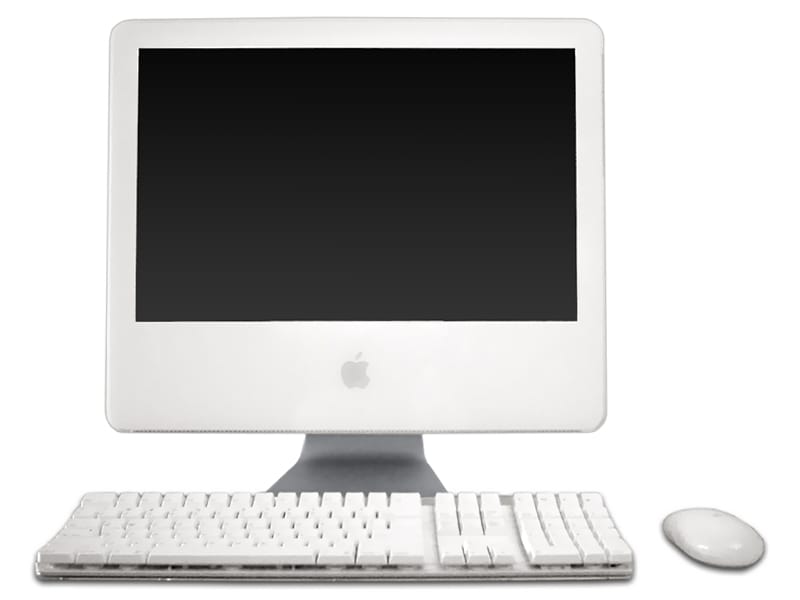
The iMac G5 put the computer inside the display. The iPhone and iPad turned the display into almost the entire product. MacBooks became increasingly thin slabs. So much of Apple’s hardware designs since then have tended towards variations on the same basic idea: a sheet of glass, a piece of aluminium, and as little else as possible.
The HomePad seems different, and honestly it probably needs to be different, including functionally. It’s said to have a 6-inch display, running a new operating system, with Apple’s revamped Siri at its heart. Available in both tabletop and wall-mounted versions, the device will be able to recognise different members of the household using voice and facial recognition, changing what’s on screen to show that person’s information.[10] The tabletop version will likely end up sitting on a kitchen counter, or beside the couch; on a desk, by the bed, or on a shelf. It has to face you rather than asking you to pick it up. It has to know who is standing in front of it and it has to show you something without an expectation that you hold it. It also has to be approachable, and thankfully, Apple appears to have remembered that products can have personality and be playful (just look at the MacBook Neo).
In recent years we’ve been primed to expect that the future of computing is about voice assistants, ambient computing, AI agents — things which might make screens less important. Well I still really like my screens, and to be honest I really like having a sense of separation between myself and the technology I'm using. I’m very attracted to the idea of something you can move, turn, glance at, walk past, talk to, ignore, and come back to later.
The iMac G4 was marketed as being the “ultimate centre of our emerging digital lifestyle” by Apple — built around digital photography, music and video and integrated with iTunes and the iPod. With the HomePad, Apple seems to be drawing on a similar idea, but with the user being the gravitational centre, because the HomePad won’t necessarily belong to one person, and might belong to many people in a household. The G4 physically oriented its screen towards you; the HomePad will have to orient the experience towards whoever the user is.
My calendar isn’t your calendar; my messages aren’t your messages; my photos aren’t your photos. The HomePad has to understand who's standing in front of it and orient itself toward whoever is using it.[11] It won’t have one fixed sun the way Clytie did; it will need to keep turning from one sun to the next, all day.
Ovid's telling has Clytie becoming a heliotrope, not a sunflower. Sunflowers are native to the Americas and were unknown to the ancient Mediterranean world. The two became conflated in later tradition, helped by their shared association with the sun. ↩︎
Young sunflowers track the sun east to west during the day, driven by a circadian rhythm that makes one side of the stem grow faster than the other. As the plant matures, the stem stiffens and that daily movement stops, fixing the flower head facing east. Researchers at UC Davis and UC Berkeley discovered the mechanism in 2016; a follow-up study found the reason: east-facing flowers warm up faster in the morning, which triggers pollen release and attracts around five times more pollinating insects than west-facing ones. Who knew? ↩︎
Bloomberg’s report, as relayed by 9to5Mac, says Apple’s smart home hub is due to launch on October 13th and that the tabletop model will take design cues from the iMac G4. The HomePad name remains a reported name rather than an Apple-confirmed product name. ↩︎
Walter Isaacson himself, in a 2012 NPR interview describing the scene directly: "They were walking around, and they just looked at the sunflowers and how there's a certain essence of the sunflower, and how it floats above the plant — and that became that iMac." ↩︎
Apple’s January 2002 announcement described the 15-inch LCD as a screen that “floats in mid-air” and said users could adjust its height or angle with a touch. ↩︎
I once did something similar. Many years ago I had the idea of getting my old iMac G4 out of the attic, removing the original screen and somehow attaching an iPad to the arm. I can’t remember which iPad it was (it may even have been the original), and I can't remember exactly how I attached it, I think I used a polycarbonate shell that the iPad snapped into. I had, in effect, turned an iMac into an iPad stand. The novelty eventually wore off. I stopped using it, and eventually got rid of the iMac G4 altogether. I rather regret that now. ↩︎
The DockLite G4 is compatible with 17-inch and 20-inch iMac G4 models, but not the 15-inch model. It provides HDMI input, USB connectivity and an audio amplifier while retaining the original display and speakers. ↩︎
The 15-inch iMac G4 was introduced in January 2002, the 17-inch model in July 2002, and the 20-inch model in November 2003. The 20-inch model was discontinued in July 2004. (EveryMac) ↩︎
Apple introduced the iMac G5 on 31 August 2004, moving the computer’s components into a two-inch-thick display and replacing the G4’s articulated arm with an aluminium stand. ↩︎
There will apparently be a ‘guest mode’ that hides personal information. ↩︎
There are rumours that a future version of the HomePad will quite literally do this — the smart display will come with a robotic arm that can tilt and rotate the screen to follow users during video calls. ↩︎