Don’t Worry, They’re Not Really Cameras
Apple’s AirPods cameras problem won’t only be the cameras.
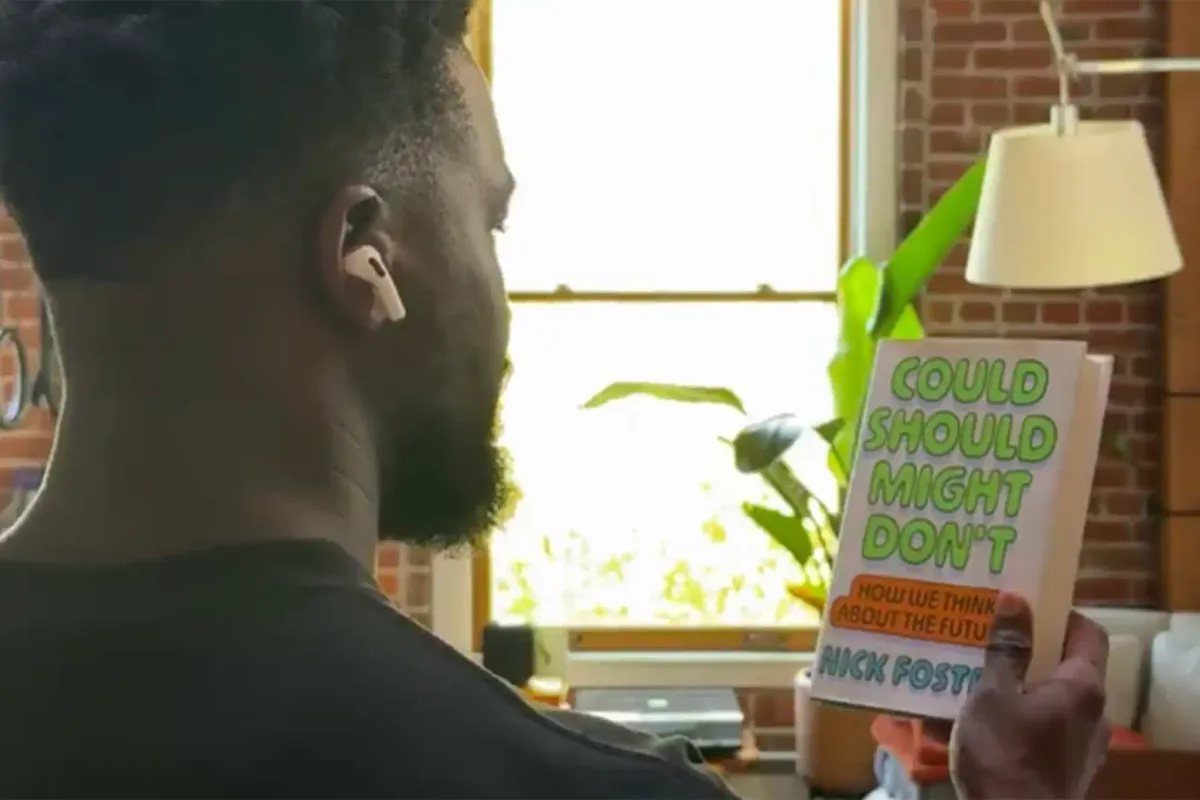
Back on August 17th, MacRumors reported that Apple is working on camera-equipped AirPods, after finding a video demo buried in the macOS Tahoe 26.7 Release Candidate.
In the video, which is very brief, a man holds up a book so that the cameras in his AirPods can see the title. A voiceover says: “With Visual Intelligence, your world becomes saveable. See something you like, just ask me to save it for later.”
There has been a bit of talk about the surveillance implications. We’ve seen something similar with Meta’s smart glasses, which have acquired some very unfortunate nicknames, including “pervert glasses” (some developers have designed apps to identify if someone nearby is wearing such glasses). This doesn’t just impact how people view the person wearing the glasses, it also impacts how the person wearing them views themselves (one journalist for The Guardian said it made her feel like a creep).
In a post on the Spyglass blog, M.G. Siegler rightly notes that Apple prides itself on its reputation around user privacy and trust, and wonders if it is really going to throw all of that away by putting cameras on people’s ears.
Siegler points out these aren’t necessarily 'cameras' in the way that we normally think of cameras. According to code analysis by a MacRumors forum member, mactracker, the AirPods appear to capture images for Visual Intelligence rather than taking photos in the conventional sense [1].
In short: the camera captures an image; the image is fed into Visual Intelligence; Siri can use that information to understand the wearer’s surroundings; there is no current evidence that the user is taking conventional photographs with the AirPods, or that they’re designed to continuously record video.
Siegler feels that Apple will downplay the picture-taking capabilities of the cameras, but acknowledges that, in reality, they’re going to have to capture some sort of image.
According to code analysis, when the cameras are operating in “active” mode (likely triggered by the user via Siri) the AirPods capture a 640 × 640 image and return a processed 1024 × 1024 image (there also appears to be a lower-resolution “passive” mode, in which the AirPods capture a 320 × 320 image). Siegler points out that the active-mode image is a “comically small, low-resolution image” and thinks Apple will talk up this low-resolution, as well as the on-device processing. Whilst he acknowledges that "some people will still just hear and see wearable cameras here”, he suspects that society will eventually grow numb to the technology.
Whilst it’s true that the technical story is considerably more complicated than “Apple is putting spy cameras in your AirPods”, I’m not convinced the technical story matters that much.
Imagine a man on a train making a woman uncomfortable because he appears to be activating the cameras in his AirPods. She says: “Are you recording me?” And he replies: “No, honestly. They’re not really cameras in the traditional sense. They’re capturing 640-by-640 images for Visual Intelligence.”
That’s not going to fly. It doesn’t matter how technically accurate the explanation is. Similarly, Apple can explain the technology perfectly in the marketing, and still lose the perception battle. It doesn’t really matter what the cameras technically do. What matters is what everyone else around the wearer imagines they’re doing.
Apple is extraordinarily good at shaping the relationship between its products and its users. It understands that a product isn’t simply a collection of technical specifications — it’s an object that exists in the real world, surrounded by other human beings.
The Vision Pro, which I would argue was a notable misstep in this regard, was Apple’s attempt to introduce a highly personal ‘spatial computer’ into people’s physical/social environment. Whilst the product’s price and thin software library get most of the blame for its slow start, when Apple debuted the product they weren’t simply asking people to buy a ‘spatial computer’ — they were asking them to strap a spatial computer to their face. And that was enough to put many people off (including yours truly, someone who owns every other Apple product going). Customers were also asking themselves what other people would think about them wearing the product. Would it make them look ridiculous? Would it make them look as though they’d opted out of the world around them?
AirPods with cameras might further exacerbate other people’s perception of the wearer as a central problem. That’s a difficult and sticky problem for Apple to solve.
We’ve already seen the beginnings of this with smart glasses. In the UK, camera-equipped smart glasses are facing bans or restrictions at certain venues. The Guardian reports that cinemas across the UK are considering banning customers from wearing Meta’s smart glasses amid fears they could be used to pirate films. Meta has built privacy safeguards into its glasses — there’s a recording indicator; there are mechanisms designed to prevent people from secretly disabling it (not always successfully). And yet people remain uncomfortable.
Apple’s privacy reputation is part of the product, it’s ‘baked in’. Apple has spent years telling us that privacy is a fundamental human right. That gives Apple something valuable — trust. But trust isn’t binary — it’s not that you either trust Apple or don’t trust Apple. Trust can gradually be eroded by lots of small experiences (“death by a thousand cuts”).
True, Apple's privacy reputation has proven remarkably durable (Siri recording controversies, App Tracking Transparency loopholes, etc), but those were all stories about what Apple does with your data. This isn’t about the wearer's privacy at all, it's about the privacy of everyone standing near the wearer, and the people making the judgement won’t necessarily be Apple’s customers. Apple will need to solve the perception problem for the people who aren’t wearing the AirPods.
I live in the UK, where we’re already accustomed to a remarkably high level of surveillance. London has long been cited as one of Europe’s most heavily surveilled cities (although admittedly the precise figures depend on how surveillance cameras are counted). I’m not comfortable with being surveilled. I don’t even particularly like somebody taking family photographs at a tourist attraction while I happen to be walking past. I don’t want strangers pointing cameras at me. And I certainly don’t want to become accustomed to the idea that the people around me might be wearing tiny cameras in their glasses, or AirPods, that I cannot see.
Stuff.tv published a first-person account from Esat Dedezade, who actually wears Meta’s smart glasses every day. His conclusion is similar to the problem I’m describing here: he knows what the glasses are doing; everyone around him doesn’t. Apple’s cameras would be attached to a product that millions of people already wear and which, until now, has been culturally understood as nothing more sinister than a pair of headphones.
Apple will likely ship a capture indicator light and call the problem solved. My guess is it won't be. The environment Apple will walk these AirPods into is one where the public has been primed to treat wearable cameras as a threat. That creates a social problem for Apple that no amount of technical explanation can completely solve [2].
MacRumors has given us some further details — MacRumors forum member mactracker found code in macOS Tahoe 26.7 suggesting that the cameras will also detect the position of the display the user is looking at, to improve the spatial audio experience. ↩︎
Parker Ortolani recently wrote about how smitten he was with the new Pebble Index, a smart ring with a button that you press and hold to activate a LLM that uses speech recognition to save requests to your phone — for notes, reminders, quick notes, etc. He has found the experience of using it very “unbelievably natural”, and importantly, “socially inoffensive. It’s a form factor people already love, it’s not distracting,…. It could be the first truly noncontroversial AI-first hardware.” ↩︎