Watch What You Say
Apple's new Audio Intelligence features protect your privacy. What about everyone else’s?
Apple has spent years telling us that privacy is a “fundamental human right”. Its latest Apple Watch features are a rather curious demonstration of how complicated that becomes when the person whose privacy you’re protecting isn’t necessarily the person wearing the product.
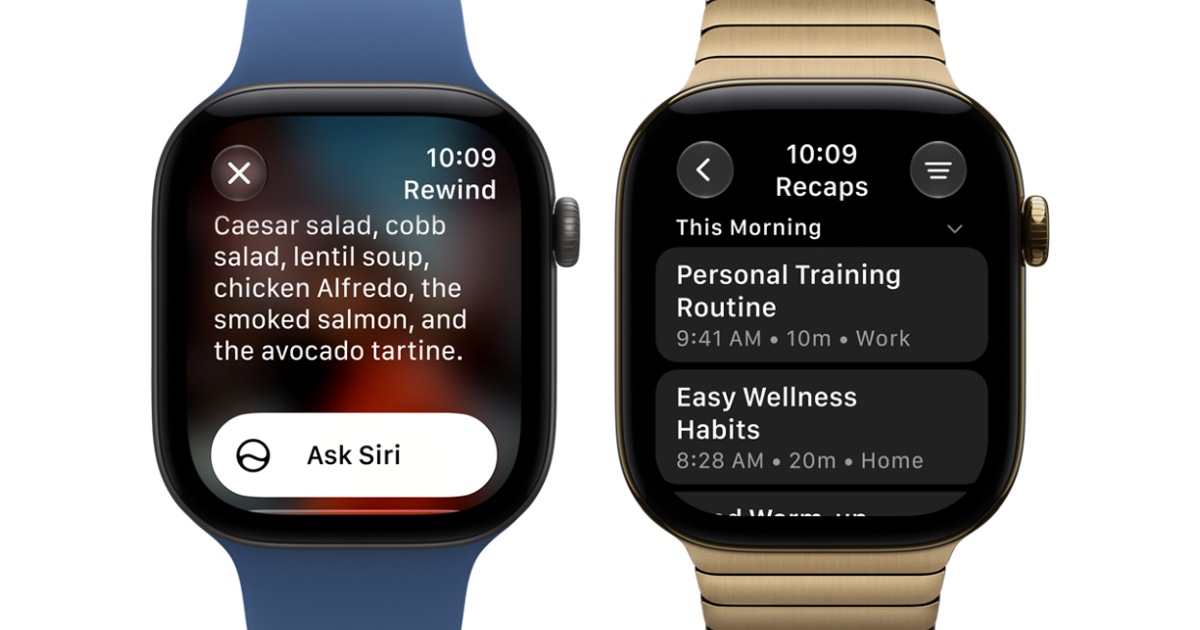
During Apple's pre-recorded keynote on the 9th of September 2026, the company announced a new set of Audio Intelligence features for the Apple Watch Series 12 and Ultra 4. They include Sound Recognition, which can detect things such as sirens, alarms, doorbells and a baby crying; Music Recognition (using Shazam); Live Rewind, and Siri Recap. [1]
Live Rewind is, Apple claims, designed for moments when you might miss a few words during a conversation and want to check what was said — double-press the Digital Crown and the Watch can show you a text snippet of the previous 15 seconds of conversation. You can then ask Siri about it, or save the snippet to the Siri app for future reference.
Apple suggests that the feature will come in handy when somebody is speaking too quickly, or if a sentence is said in an unclear way, or if the user misses part of what was said. Apple says that the watch doesn't continue listening or transcribing after the feature is activated, and the text doesn't stay on the watch in perpetuity (text transcripts disappear around after around 30 seconds, unless the user has saved it to the Siri app).
Siri Recap, on the other hand, is a bit of a different animal. Apple says that Siri Recap “ambiently takes notes on your conversations throughout your day” and creates high-level summaries that you can look at later. You can tell it to operate at particular times or locations (“only at work”, for example, or “never at night”) or toggle it on/off from Control Centre.
Apple is keen to stress that Siri Recap doesn’t create a permanent transcript. It produces a brief summary, apparently comparable to “notes you might jot down after a conversation”. Audio isn’t recorded or stored. The raw audio is processed inside the Secure Exclave on the Watch and iPhone, where it’s inaccessible to the operating system, apps, the user and Apple, and is then deleted. An encrypted, condensed version of the conversation is sent to Private Cloud Compute to produce the final summary, which is automatically deleted after seven days unless you save or export it. Saved summaries and Live Rewind snippets are end-to-end encrypted when synced through iCloud.
What's revealing, given some of the arguments I was making in my “Don’t Worry, They’re Not Really Cameras” piece, is that Apple has clearly given some thought into the privacy of the people around the person wearing the watch. There is a dedicated section in their support documentation called: “How Audio Intelligence features protect the privacy of those nearby”.
Firstly, Live Rewind is deliberately conspicuous — when you activate it, the Apple Watch makes an audible chime, even if it’s on silent or you’re wearing headphones. There’s also a full-screen animation and a microphone indicator.
Apple is also at pains to assure us that the user is ‘in control’. Audio Intelligence features are ‘opt-in’. Siri Recap doesn’t identify and attribute individual speakers, and will omit “potentially harmful content or sensitive data”, which includes language that promotes self-harm, hate speech (defined by Apple, I assume?), financial data, government-assigned identifiers, authentication data, and certain personal identifiers. There is a big fat asterisk here however — “Siri Recap summaries and Live Rewind text snippets are generated using Apple Intelligence and may be incomplete or inaccurate. Important details may be omitted, misunderstood, or summarized incorrectly”.
But then, rather wonderfully, Apple tells us: “Be mindful of those around you. While audio is not recorded or stored and no speakers are attributed, consider those around you where conversations might be private or sensitive.”
There are some glaring problems here. The features may be opt-in for the person wearing the watch, but they aren’t opt-in for the people around the wearer. And Apple’s assurances really only amount to a list of elaborate and specific technicalities. If the public equates someone wearing an Apple Watch with: “I need to watch what I say around this person”, then these technicalities aren't going to mean a hill of beans.
I go back to the example I used in my AirPods with Cameras piece again: imagine a man on a train making a woman uncomfortable because he is wearing his Apple Watch (remember there's no way to tell from the outside whether Siri Recap happens to be “ambiently taking notes on your conversations” at that moment). She says: “Are you recording me?” And he replies: “Don’t worry. There’s no speaker attribution. Potentially harmful or sensitive information is omitted. It’s not a full transcript, it’s just a summary. The relevant data is encrypted and processed using Private Cloud Compute. The raw audio isn’t recorded or stored, it’s processed in the Secure Exclave on my Apple Watch and iPhone. The summary auto-deletes after seven days unless I’ve saved it to the Siri app, which I may or may not have done. And don’t worry, anything saved to my other devices is end-to-end encrypted”.
Come on. This is not going to fly. This is in the realms of pure Monty Python.
And whilst these features are exclusive to the new Apple Watch Ultra 4 and Series 12, previous Ultra models, and every other Apple Watch, look identical or near-identical to these. So even if my Apple Watch doesn't have Audio Intelligence features at all, nobody standing near me can tell that — they'll have no way of knowing whether my Apple Watch is quietly summarising our conversation, or not. All they see is someone wearing an Apple Watch. Thanks, Apple.
To give Apple credit, they've clearly thought about misuse — Live Rewind and Siri Recap won't be available at all for users under 13, and anyone under 18 needs a parent or guardian to switch them on via a Child Account. Which tells you Apple is at least aware that these features could be misused, or misunderstood, or weaponised (in ways the marketing copy doesn’t dwell on). But has it occurred to Apple that the person you're having a conversation with might also be a child, or might also deserve some say in whether they're being quietly summarised into a Siri app they'll never see?
Some of these questions came up shortly after launch. John Ternus (CEO) and Greg Joswiak (Senior Vice President Worldwide Marketing) were interviewed by Tech Radar and Tom’s Guide and asked specifically about privacy implications:
Ternus:
We wanted to build something that was very privacy first, right? And so you look at Siri Recap and there is no transcript. There is no recording. Like, even the owner of the watch can't see the recording. It doesn't exist. There's no transcript. There's no speaker attribution. Like, we wanted to do this in a way that people feel comfortable using it and people around the user feel comfortable about its existence.
Joswiak:
If we don't have a recording, it means no one else has a recording, right? It can't get hacked. It is Apple doing this sort of feature, which there's clearly a need and a desire for, so we can all kind of stay in the moment, right, as we're having meetings or discussions… it was just that higher level notes to remind you of that without getting into all the stuff that really is privacy concerning, which a lot of other products are doing.
It feels like Apple has a few blind-spots here:
- For other people to “feel comfortable” about these features, the wearer of the Apple Watch, or Apple themselves, will need to technically explain these distinctions and assume everyone will understand (and be comfortable with said explanation).
- More fundamentally, regardless of how well the technical aspects are explained, what if people don't consent to being “summarised” in this way?
- Does this really help anyone “stay in the moment” in the way Apple is suggesting? Imagine I’m sitting in a Starbucks talking to a friend about my finances, or my relationship, or my health, or my job. I notice their Apple Watch. I don’t know what it’s doing — maybe it’s doing nothing, or maybe it’s listening. Maybe Siri Recap is scheduled to operate at that particular moment, or not. I don’t know. Suddenly I’m having to watch what I say, which is hardly helping anyone “stay in the moment”.
As Ternus himself observed, in an interview after Apple's September event with Canal+ talk show Clique:
Once you give something up, you can never get it back, right? Like once your personal information, you offer it up, like it's no longer yours anymore.
So the question Apple really needs to ask itself is this: do some of the benefits these features provide (using Live Rewind, for example, to remember what a waiter said the specials were on a menu), outweigh the potential harms to people's sense of privacy? I use that word deliberately — their sense of privacy. Because Apple’s answer to all of this really appears to be, “there’s no recording”, and “there's no speaker attribution”.
And Apple’s benign exemplar use cases for these features might not end up being how they are used. Imagine you’ve have had a disagreement with your spouse. Say, for example, one of you claims to have reminded the other to pick up some bread on the way home, and the other has no recollection of this. Many disagreements between people revolve around both parties having a very different recollection of what was said, with both sides entrenched in their own perspectives and specific memories, even though memory is notoriously fallible. [2]
If one or both of you are wearing an Apple Watch, Siri Recap can now settle who's misremembering, right? The Apple Watch (paired with the iPhone) will have a machine-generated summary of the conversation. It will be able to confirm whether bread was mentioned at all, regardless of speaker attribution. Fantastic. Forget "my truth" and "your truth", everyone will now have "Apple Truth (™)". [3]
I would argue that human beings, by and large, don’t want to live in a world where there are devices in their homes and workplaces ambiently taking notes on their conversations throughout the day. And the reason that societies by and large haven't historically done this sort of thing (repressive societies like East Germany's Stasi notwithstanding [4]) is because most people are repelled by the sense that that they are being constantly surveilled, monitored and “summarised”.
So I have some imaginative suggestions that I would like Apple to consider as alternatives to these “Audio Intelligence” features:
-
Instead of Live Rewind, which is designed for moments where you might miss a few words during a conversation and want to check what was said… I suggest encouraging to the user to just ask the person to repeat themselves.
-
Instead of Siri Recap, which “ambiently takes notes on your conversations throughout your day… that you can use later to jog your memory so you can stay present in the moment”… I suggest encouraging users to stay present in the moment themselves, rather than outsourcing their critical memory faculties to a watch on their wrist.
I petition Apple to update their Audio Intelligence support document accordingly.
These features won't actually arrive until a beta rollout "later this year”, but the fact that Apple is already this far along in explaining how they work, and how they'll protect your privacy, tells you Apple is confident these are coming. Live Rewind and Siri Recap will not initially be available in the EU. ↩︎
This isn't just a folklore by the way— it's one of the most well-established findings in psychology. Loftus and Palmer’s 1974 research showed that simply changing the wording of a question after the fact (asking whether two cars "hit" each other versus "smashed into" each other) measurably altered what people remembered seeing, sometimes conjuring memories of broken glass that was never there. Memory is not a recording — it’s a reconstruction, rebuilt slightly differently every time. ↩︎
Disclaimer: Siri Recap summaries and Live Rewind text snippets are generated using Apple Intelligence and may be incomplete or inaccurate. Important details may be omitted, misunderstood, or summarized incorrectly. ↩︎
East Germany's Stasi had, at its peak, roughly “one informer per 6.5 citizens. It would not have been unreasonable to assume that at least one Stasi informer was present in any party of ten or twelve dinner guests. Like a giant octopus, the Stasi's tentacles probed every aspect of life.” ↩︎